

Difference Between Injection Pressure and Machine Injection Pressure
Understand how melt pressure, hydraulic pressure and the machine pressure intensification ratio influence injection molding performance, machine selection and Moldex3D simulation results.
Injection molding is widely used to manufacture plastic components with high accuracy, repeatability and production efficiency. During mold design, process optimization or mold flow simulation, engineers frequently encounter two pressure-related terms: Injection Pressure and Machine Injection Pressure.
Although these terms are closely related, they do not always represent the same pressure value. Understanding the difference is important when interpreting simulation results, selecting an injection molding machine and troubleshooting filling-related defects.
What Is Injection Pressure?
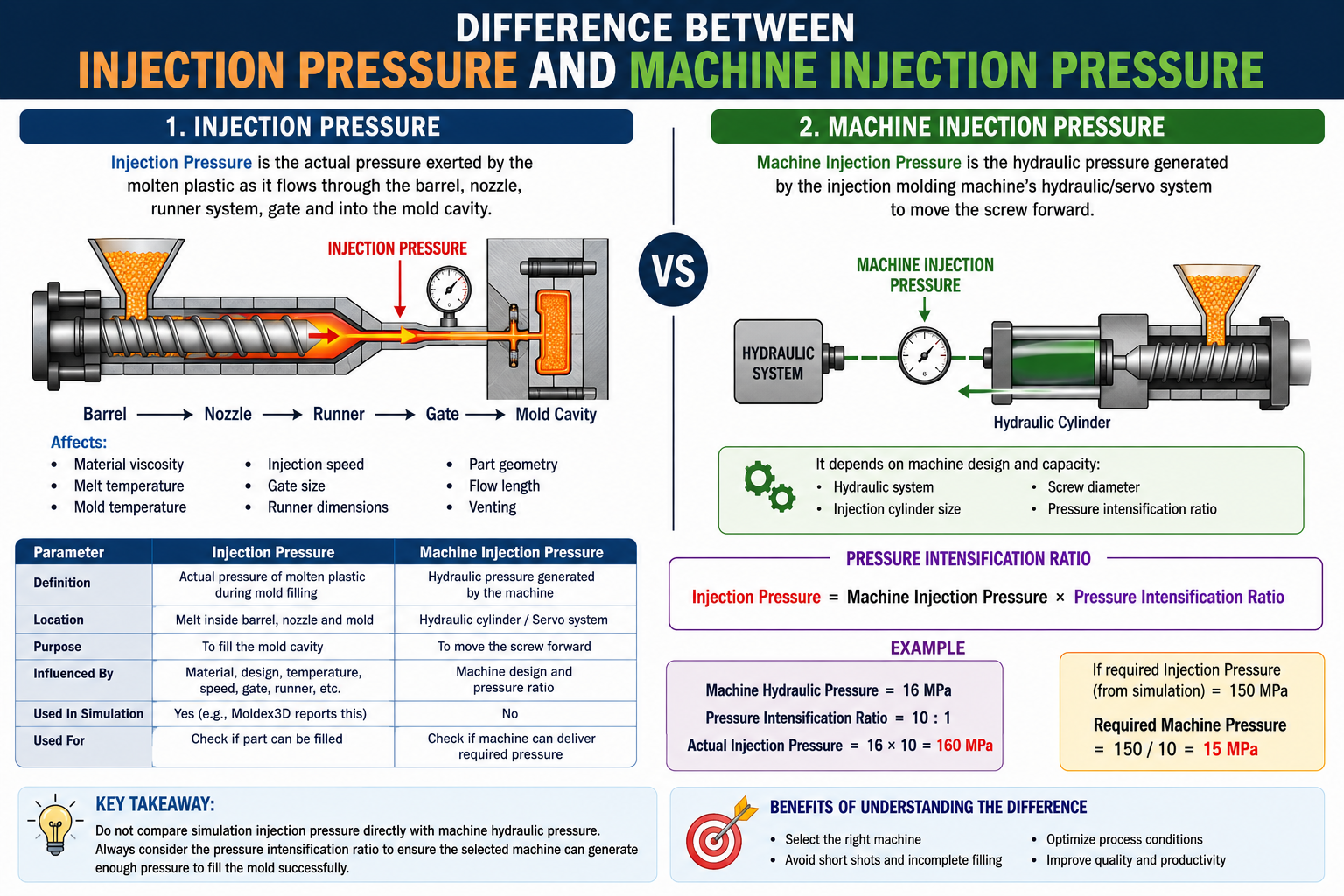
Injection Pressure is the actual pressure exerted on the molten plastic by the injection screw during mold filling. It pushes the melt through the machine nozzle, sprue, runner system, gate and mold cavity.
The injection pressure must overcome the flow resistance created by the plastic material, runner system, gate geometry and product design.
Purpose of Injection Pressure
Its main purpose is to move the molten plastic through the complete flow path and fill every section of the cavity before the material freezes.
Factors Affecting Injection Pressure
- Material viscosity
- Melt and mold temperature
- Injection speed
- Gate and runner dimensions
- Wall thickness and flow length
- Part geometry and venting
What Is Machine Injection Pressure?
Machine Injection Pressure is the pressure generated by the injection molding machine's hydraulic or servo system to move the injection screw forward.
In a hydraulic molding machine, the hydraulic pressure acts on the injection cylinder. The resulting force pushes the screw forward and creates a much higher pressure in the molten plastic.
Machine Injection Pressure Depends On
- Hydraulic or servo system capacity
- Injection cylinder diameter
- Injection screw diameter
- Available injection force
- Machine pressure intensification ratio
Relationship Between the Two Pressures
In a hydraulic injection molding machine, the hydraulic pressure is converted into plastic melt pressure through the machine's pressure intensification ratio.
Example Calculation
Machine hydraulic pressure: 16 MPa
Pressure intensification ratio: 10:1
Therefore, although the machine's hydraulic system produces only 16 MPa, the molten plastic can experience an injection pressure of approximately 160 MPa.
Injection Pressure vs Machine Injection Pressure
| Parameter | Injection Pressure | Machine Injection Pressure |
|---|---|---|
| Definition | Actual pressure applied to the molten plastic during filling. | Hydraulic or servo pressure generated to move the injection screw. |
| Location | Molten plastic inside the barrel, nozzle and flow system. | Hydraulic injection cylinder or servo injection drive. |
| Main Purpose | Push the melt through the runner, gate and cavity. | Generate the screw force required for injection. |
| Influenced By | Material viscosity, geometry, gate size, temperature and speed. | Machine design, cylinder diameter, screw size and drive capacity. |
| Common Unit | MPa, bar or psi | MPa, bar or psi |
| Use in Mold Simulation | Used to evaluate the pressure required to fill the mold. | Used to verify whether the selected machine can supply sufficient pressure. |
Practical Moldex3D Example
Assume a Moldex3D filling analysis predicts that a component requires a maximum injection pressure of 150 MPa.
The selected machine has a pressure intensification ratio of 10:1.
The machine must therefore generate at least 15 MPa of hydraulic pressure to produce 150 MPa of plastic injection pressure.
If the machine can generate only 12 MPa hydraulic pressure, the maximum available plastic pressure will be:
Since the required pressure is 150 MPa, this machine may not be able to fill the component completely under the simulated conditions.
Possible Problems When Pressure Is Insufficient
Why This Difference Is Important
A common mistake is to compare the maximum injection pressure predicted by simulation directly with the hydraulic pressure shown on the molding machine.
Before making the comparison, engineers must determine whether the machine specification refers to:
- Hydraulic pressure
- Plastic or specific injection pressure
- Injection force
- A percentage of the machine's maximum pressure setting
How Moldex3D Helps
Moldex3D can estimate the pressure required to fill a plastic component before the mold reaches production. Engineers can use the simulation results to:
- Review maximum injection pressure
- Check pressure distribution throughout the cavity
- Optimize gate location and gate size
- Balance multi-cavity runner systems
- Evaluate material alternatives
- Optimize melt temperature and injection speed
- Check whether the proposed machine is suitable
Frequently Asked Questions
Is injection pressure the same as cavity pressure?
No. Injection pressure is generated near the screw tip or nozzle. Pressure gradually drops as the melt flows through the nozzle, runner, gate and cavity. Cavity pressure is the pressure measured or predicted at a specific location inside the mold cavity.
Does Moldex3D report hydraulic pressure?
Mold flow simulation normally evaluates the pressure experienced by the molten plastic. Hydraulic pressure must be calculated or verified using the machine's pressure conversion or intensification ratio.
Can a larger gate reduce injection pressure?
In many cases, increasing the gate or runner cross-section reduces flow resistance and lowers the required injection pressure. However, gate design must also consider appearance, gate removal, packing and product quality.
Why does injection pressure increase for thin-wall parts?
Thin sections create higher resistance to melt flow and cool more quickly. Higher injection speed and pressure may therefore be required to fill the cavity before the flow front freezes.
Conclusion
Injection Pressure and Machine Injection Pressure are related but technically different.
Injection Pressure is the actual pressure applied to the molten plastic during mold filling, while Machine Injection Pressure is the hydraulic or servo pressure used to move the injection screw.
Understanding the pressure conversion relationship is essential for selecting the correct molding machine, interpreting Moldex3D simulation results and achieving stable, defect-free production.
Need Support with Mold Flow Analysis?
Rheologist Gaze & Solutions provides Moldex3D simulation, filling analysis, packing analysis, cooling optimization, warpage prediction, gate optimization and injection molding process support.
Contact Rheologist Gaze & Solutions